Why growth often feels messy before it feels meaningful
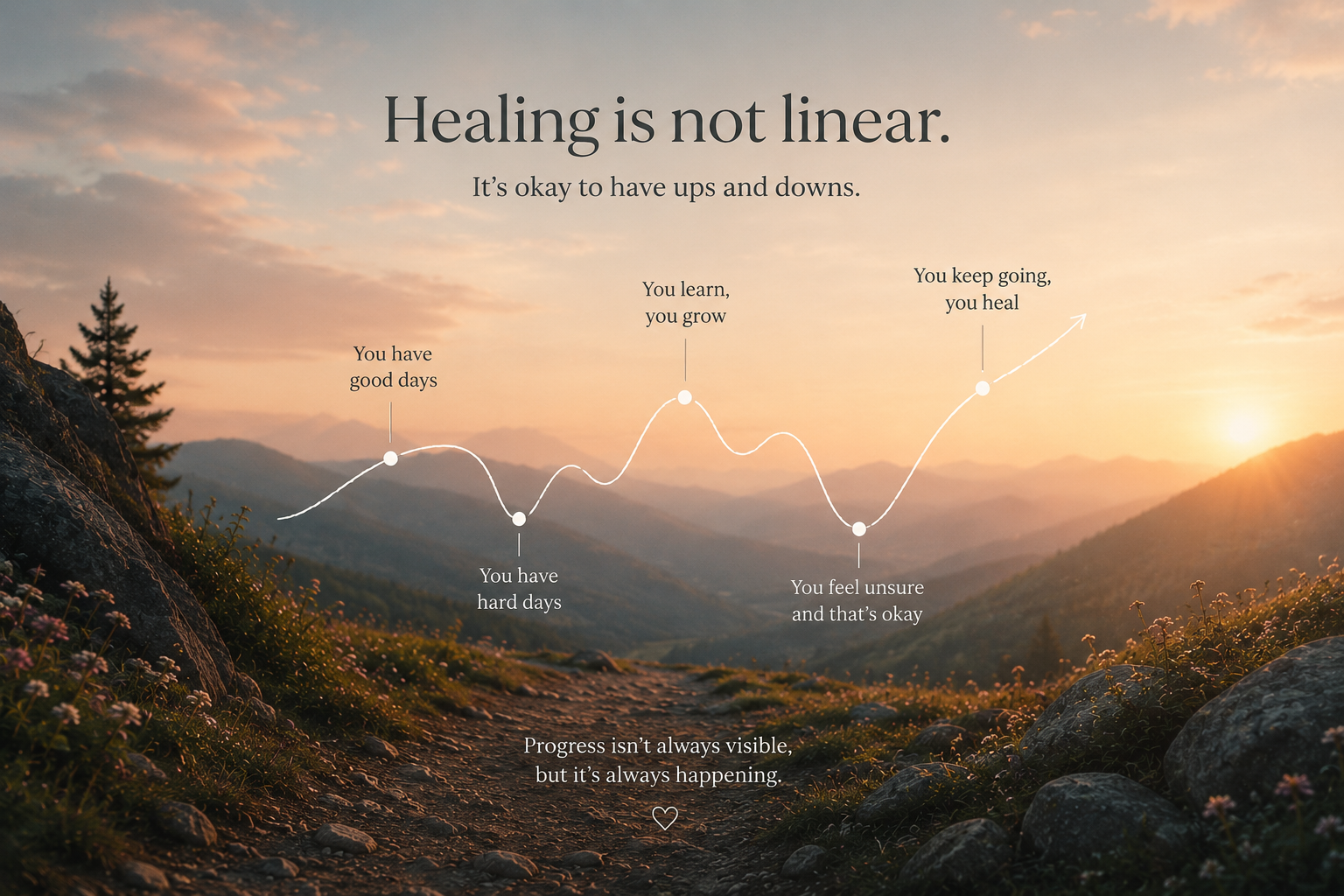
One of the biggest misconceptions about healing is the belief that it should move in a straight line.
Many people begin their healing journey expecting that once they start “doing the work,” everything will steadily improve. They imagine becoming calmer, stronger, happier, and more emotionally balanced week by week until eventually they arrive at a healed version of themselves. But real healing rarely unfolds that way.
In reality, healing is often unpredictable, emotional, uncomfortable, and deeply non-linear.
You may find yourself:
- overthinking again,
- feeling emotionally drained,
- revisiting old fears,
- struggling with anxiety,
- or reacting in ways you thought you had already moved beyond.
And when this happens, many people assume they are failing. But healing does not move backwards and forwards in the way we often think it does. More often, healing happens in layers.
Healing Is Not A Straight Path
Growth is rarely a smooth upward climb. It is more like walking through unfamiliar terrain:
- sometimes clear,
- sometimes confusing,
- sometimes peaceful,
- sometimes emotionally heavy.
You can experience deep progress while still having difficult days. You can become more self-aware while still occasionally falling into old patterns. And you can be healing even when it doesn’t feel like you are.
This is important to understand because many people abandon their healing journey too early simply because they expected it to feel more linear than it actually is. But healing is not about never struggling again. It is about changing your relationship with yourself, your emotions, and your experiences over time.
Sometimes Old Emotions Return Because You Finally Feel Safe Enough To Process Them
This is one of the most misunderstood parts of healing. People often think:
“Why am I feeling this again? I thought I had moved past this.”
But emotional healing is not always about emotions disappearing forever. Sometimes emotions return because your nervous system finally feels safe enough to process what it previously suppressed.
For years, many people live in survival mode:
- constantly busy,
- emotionally disconnected,
- overstimulated,
- distracted,
- or focused entirely on coping rather than processing.
And when life finally slows down, unresolved emotions can begin surfacing.
Not because healing is failing —
but because healing is beginning.
Healing Often Feels Messy While You’re Inside It
One of the challenges of healing is that growth often feels unclear while it’s happening.
From the outside, healing is usually imagined as calm and peaceful. But internally, it can feel like:
- confusion,
- grief,
- discomfort,
- uncertainty,
- emotional exhaustion,
- and learning how to let go of versions of yourself that no longer align with who you are becoming.
There is often a grieving process involved in healing. You may grieve:
- relationships,
- lost time,
- unhealthy patterns,
- old identities,
- or the fact you spent so long abandoning your own needs.
That grief is not weakness. It is part of emotional honesty. And often, honesty is where real healing begins.
Progress Is Not Always Visible
We tend to measure healing by visible outcomes. We look for dramatic transformations:
- constant happiness,
- complete confidence,
- emotional perfection,
- or the absence of struggle.
But some of the most important healing is subtle. It may look like:
- pausing before reacting,
- setting healthier boundaries,
- allowing yourself rest,
- becoming more self-aware,
- choosing peace over chaos,
- or finally recognising your own worth.
These changes may not appear dramatic from the outside, but over time they completely change the way you experience life. Healing is often quiet before it becomes visible.
Social Media Has Created Unrealistic Expectations Around Healing
Modern healing culture often presents growth as something aesthetically perfect.
Perfect routines.
Perfect mindfulness practices.
Perfect positivity.
But healing is not a performance.
It is not about appearing healed.
Real healing is usually far less polished than what we see online.
Sometimes healing looks like:
- crying unexpectedly,
- cancelling plans because you need rest,
- learning to say no,
- sitting with difficult emotions,
- walking away from unhealthy environments,
- or slowly rebuilding trust with yourself after years of self-neglect.
And none of those things look glamorous. But they are often where the deepest transformation happens.
Be Patient With Yourself
Healing requires patience because meaningful change takes time. Many people expect themselves to heal quickly while carrying years of emotional stress, conditioning, burnout, heartbreak, or self-abandonment.
But healing is not a race.
Growth often feels messy before it feels meaningful.
There will be moments where you question your progress.
Moments where you feel stuck.
Moments where you wonder if anything is changing at all.
Yet often, the shifts are already happening quietly beneath the surface.
You are learning.
Becoming more aware.
Responding differently.
Beginning to reconnect with yourself.
And those small internal shifts matter more than you realise.
Healing Is About Reconnection, Not Perfection
At its core, healing is not about becoming flawless. It is about returning to yourself. It is about:
- creating emotional safety,
- understanding your patterns,
- slowing down enough to hear yourself again,
- and learning that your worth is not dependent on how much you achieve, fix, or prove.
Healing doesn’t remove every difficult moment. It changes the way you move through them.
And perhaps that is what real healing truly looks like.
Not perfection. But presence.